



Chevrolet Silverado 1500 Towing Tips for Bellefontaine Truck Owners
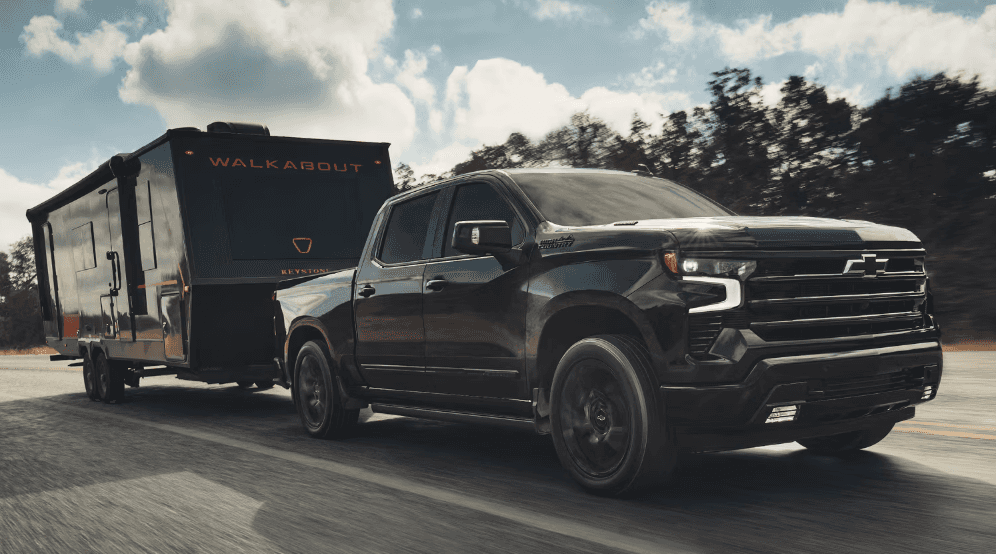
Hooking up a trailer to your Chevrolet Silverado 1500 seems simple enough until you’re halfway up a grade near Campbell Hill wondering if your load is actually within spec. Most towing headaches start before the hitch ever gets connected. This guide walks through the practical steps we recommend before any tow, and if you’d rather have our team look things over first, you can always schedule a service appointment at our Bellefontaine location.
Getting Ready to Tow: Why Preparation Matters More Than the Number on the Sticker
A lot of towing advice focuses entirely on one number: how much weight the truck can pull. That number matters, but it’s only part of the picture. Tire condition and the terrain you’re driving through affect how your truck handles once you’re loaded up too, and weight distribution ties all of it together.
We see plenty of owners fixate on towing capacity while forgetting to account for payload, passengers, and cargo, and then they can’t figure out why the truck feels unstable on the road. A good pre-towing routine catches these issues before they turn into problems on US-33 or SR-540. Know where to look and what to check every single time, and the rest takes care of itself.
Start With Your Owner’s Manual and Door-Jamb Rating
Before you connect anything, open the driver’s door and look at the Trailering Information Label. This sticker lists your truck’s curb weight, GVWR (the max your truck can weigh fully loaded with passengers, cargo, and fuel), GCWR (the max combined weight of truck and trailer together), max payload, max tongue weight, and rear GAWR (the max weight your rear axle can carry).
These figures are specific to your exact truck, not a generic number you might see quoted elsewhere. The Owner’s Manual expands on all of this and should be reviewed before you tow or even before you buy, since capacity shifts depending on passengers, cargo, and installed options.
Why Ratings Vary by Engine, Cab, Bed, Drivetrain, and Axle Ratio
Every configuration of the Chevrolet Silverado 1500 carries its own valid rating, built for a different job. The 3.0L Duramax Turbo-Diesel delivers torque and efficiency suited to long-haul trailering. The 6.2L V8 offers the strongest gas-engine output for frequent, heavier towing. The 5.3L V8 is a dependable all-around performer for mixed use, while the 2.7L Turbo fits lighter-duty or occasional towing needs.
Cab and bed configuration matter too. A short bed is often paired with a crew cab when owners want passenger space without sacrificing practicality, and Chevrolet offers multiple bed lengths depending on cab choice. Drivetrain and axle ratio further shift what a given truck can handle. Which setup is “best” really depends on your typical trailer weight and how often you’re pulling it, not just which engine sounds strongest on paper.
Calculating Payload, Passengers, Cargo, and Tongue Weight
GVWR isn’t just about the trailer. It’s calculated from your vehicle’s own weight plus cargo, passengers, and tongue weight, and that total has to stay at or under the rating on your door-jamb sticker. This is where the payload figures in your Owner’s Manual become useful, since they show how much room you actually have left once people and gear are accounted for.
GCWR works similarly but looks at truck and trailer together. The usable portion of that rating is your GCWR minus curb weight, calculated using curb weight plus 150 pounds each for the driver and front passenger. Add more passengers or cargo, and your usable GCWR shrinks further. Exceeding either rating affects handling, braking, and overall safety, which is why we always tell customers to account for everyone and everything riding along, not just the trailer hitched behind.
Getting Tongue Weight Right for Stable Towing
Tongue weight is the downward force your trailer’s coupler puts on the hitch ball, and getting it right is one of the most overlooked steps in tow prep. For conventional trailers, aim for roughly 10 to 15 percent of the total loaded trailer weight, capping around 10 percent for standard hitches and up to 15 percent for gooseneck or fifth-wheel setups at maximum trailer weight.
A balanced trailer prevents shifting during transit and keeps the truck tracking straight, especially through the rolling terrain around Bellefontaine. Tongue weight also has to stay within your rear GAWR, GVWR, and Max Trailer Tongue Load limits. Loading a trailer too far forward or too far back can create unstable trailering conditions, including trailer sway, especially at highway speeds and during heavy braking.
Hitch Equipment and Trailer Brake Setup
Getting the hardware right matters just as much as the math. This is where we see the most preventable mistakes.
Choosing the Correct Hitch Receiver and Ball Mount
Every hitch setup is really a chain of components, including the receiver, ball mount, hitch ball, safety chains, and wiring. The weakest-rated piece in that chain becomes the limit for the entire system, no matter how strong the rest of the setup is. Mismatched components are one of the most common mistakes we run into: someone pairs a heavy-duty receiver with an undersized ball mount and assumes the higher-rated piece wins out, but the setup is only as strong as its weakest link. Gooseneck and fifth-wheel hitches are typically the choice for travel trailers, horse trailers, and larger loads, while conventional receivers handle most lighter trailers just fine.
Trailer Brake Controllers and Connections
In Ohio, trailers with an empty weight of 2,000 pounds or more must be equipped with brakes that can be applied from the towing vehicle, and state law requires the vehicle-trailer combination to have parking brakes adequate to hold on any grade, with an exception for trailers under 2,000 pounds gross weight. Electric brake controllers sense your truck’s braking and apply the trailer brakes proportionally, while surge brakes are self-contained hydraulic systems that engage automatically when the trailer decelerates.
Chevrolet offers an Integrated Trailer Brake Controller as available equipment on the Chevrolet Silverado 1500. It’s not standard, so check whether your truck has it. Ignoring trailer brake sync is another mistake we see often, and it’s an easy one to catch with a quick test in a parking lot before you’re merging onto US-33 with a loaded trailer behind you.
Tires, Mirrors, and Fluids Before You Hit the Road
Both your truck’s tires and your trailer’s tires need proper inflation before towing, since low pressure under load generates heat and increases blowout risk. Some Chevrolet Silverado 1500 configurations offer Trailer Tire Pressure Monitor Sensors and Custom Trailer Profiles, though availability depends on your specific truck, so it’s worth checking the Owner’s Manual rather than assuming your setup has these features.
Mirror visibility matters more than most owners expect once a trailer is blocking the rear window. For the 2022 model year, the Chevrolet Silverado 1500 LTD offers two levels of trailering mirrors, and adjusting them properly before you leave the driveway makes a real difference in traffic. Fluid levels round out this step. Low or degraded oil and coolant put extra strain on a truck that’s already working harder to pull a load, and that strain shows up fastest on long grades or hot Ohio summer days.
Planning Your Route Through Bellefontaine and Beyond
Logan County’s terrain isn’t flat. Campbell Hill, the highest natural point in Ohio at 1,549 feet, sits northeast of Bellefontaine, and while you won’t be towing straight up it, the rolling hills throughout the area do add extra strain on brakes and transmissions during a tow. Planning your route with that in mind pays off.
US-33 runs east-west through the area, connecting toward Marysville to the east and Wapakoneta to the west, and it’s a common corridor for towing trips in either direction. US-68 runs north-south, heading toward Urbana to the south, while SR-47 heads west toward Kenton. SR-540 ends at a signalized intersection with US-68 and SR-47 right in downtown Bellefontaine, making it a useful reference point if you’re routing through town with a trailer.
Ohio also sets general limits on combined length, width, and height for tow vehicle and trailer combinations, generally 65 feet long, 102 inches wide, and 13 feet 6 inches tall, so it’s worth confirming your combination fits before setting out, particularly with taller or wider trailers. Identifying fuel stops and rest areas ahead of time also saves headaches on longer hauls, especially with a rig that’s harder to maneuver into tight lots.
Pre-Tow Service Checklist for Your Chevrolet Silverado 1500
Before any tow, we recommend running through this list:
- Test your trailer brake controller sync and confirm the connection before you leave the driveway.
- Verify tire pressure on both the truck and the trailer, not just one or the other.
- Inspect the hitch ball, receiver, and safety chains for proper matching and secure attachment.
- Test all trailer lights, turn signals, and brake lights for correct function.
- Check fluid levels including engine oil, coolant, and transmission fluid.
- Listen for brake noise. Chirping, squealing, whistling, shaking when stopping, or grinding are signs your brakes need service before towing.
- Confirm mirror adjustment gives you a clear view of the trailer and surrounding lanes.
Our certified service checklist covers all of this and more, tires, wiper blades, fluid levels, brakes, and battery health all get a look, so if you’d rather have GM-certified technicians handle the inspection, that’s exactly what our service center is set up to do.
Browse Silverado 1500 Inventory or Schedule Service Before Towing
Shopping for a Tow-Ready Truck
If you’re looking for the right configuration, browse our Silverado 1500 inventory to compare engine and cab options, and check our current new vehicle specials while you’re at it.
Getting Your Current Truck Tow-Ready
If you already own one, schedule a service appointment so our technicians can inspect brakes, hitch components, and fluids before your next tow.
Not sure which rating applies to you? Stop by or contact our team at 2500 Route 68 S, Bellefontaine, OH 43311, and we’ll confirm your exact GVWR, GCWR, and payload numbers together.
Chevrolet Silverado 1500 Towing Prep FAQ
How much can a Chevrolet Silverado 1500 tow? It depends entirely on your specific configuration. Engine, cab, drivetrain, and axle ratio all play a role. Check your Trailering Information Label and Owner’s Manual, or ask our team to confirm your truck’s exact rating.
How many pounds can a Chevrolet Silverado 1500 tow? There’s no single figure that applies to every truck. Ratings vary by engine choice and equipment, which is why we always point owners to their door-jamb sticker rather than a generalized number.
What’s the difference between GVWR and GCWR? GVWR is the max weight of your truck alone, including cargo and passengers. GCWR is the max combined weight of your truck and trailer together.
Does my Chevrolet Silverado 1500 have an Integrated Trailer Brake Controller? It’s available on the Chevrolet Silverado 1500 but not standard equipment, so check your build sheet or ask our service team to verify.
What tongue weight should I aim for? Generally 10 to 15 percent of your loaded trailer weight, staying within your truck’s rear GAWR, GVWR, and Max Trailer Tongue Load limits.
Where can I get my truck inspected before towing? Our Certified Service team at 2500 Route 68 S, Bellefontaine, OH 43311 checks tires, brakes, fluids, and hitch components before any towing trip. Schedule an appointment whenever you’re ready.

0 comment(s) so far on Chevrolet Silverado 1500 Towing Tips for Bellefontaine Truck Owners