



Chevrolet Traverse vs Honda Pilot Specs: Mid-Size SUV Performance and Capacity Compared
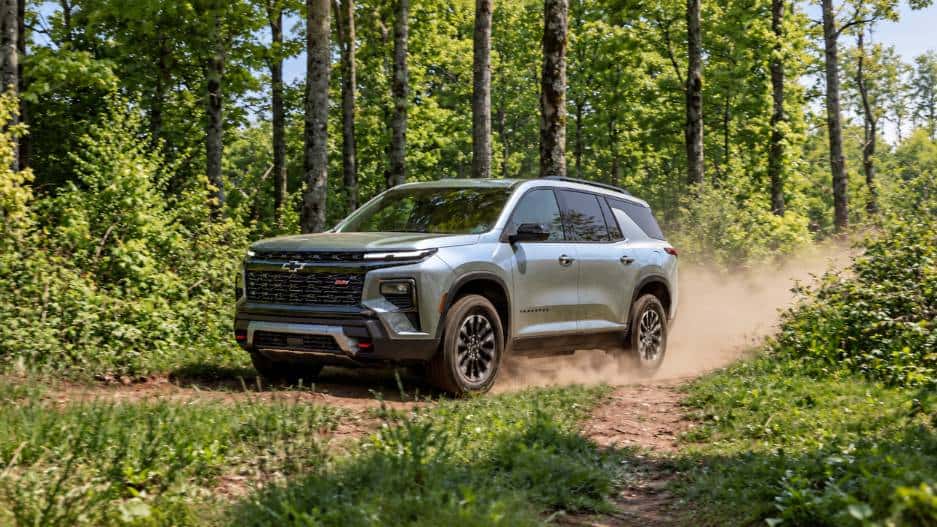
Shopping for a family SUV in Bellefontaine or Sidney usually comes down to a handful of real questions: towing capacity, whether everyone actually fits comfortably on a road trip, and whether the vehicle holds up over years of driving Logan County’s back roads. The Chevrolet Traverse vs Honda Pilot debate covers all of that ground, and the 2026 versions bring real, measurable differences worth understanding before you sign anything.
Below you’ll find the 2026 Chevrolet Traverse specs and Honda Pilot specs laid out side by side. If you’d rather skip ahead and see the Traverse in person, you can browse our current inventory of the Chevrolet Traverse anytime.
Chevrolet Traverse vs Honda Pilot: Comparing Two Family-Favorite Midsize SUVs
Both the Traverse and Pilot have earned loyal followings among Ohio families, and for good reason. They handle school runs and sports practices without complaint, with plenty of room left over for the occasional long haul. Where they start to differ is under the hood and in the numbers that matter for towing, cargo, and total interior space.
The 2026 Traverse brings a turbocharged four-cylinder engine that outmuscles the Pilot’s V6 on paper, while the Pilot counters with a longstanding reputation for reliability and a slightly more configurable third row. Neither vehicle is a bad choice, but the specifics matter depending on what your family actually does with an SUV week to week.
Engine Performance, Powertrain, and Towing Capability
Horsepower and towing capacity tend to be the first things Logan County shoppers ask about, especially anyone hauling a boat to Indian Lake or a trailer full of equipment. The table below shows where each SUV lands for 2026.
| Spec | Chevrolet Traverse (2026) | Honda Pilot (2026) |
|---|---|---|
| Engine/Powertrain | 2.5L Turbo I-4 | 3.5L V6 |
| Drivetrain | FWD, AWD available | FWD on Sport and EX-L only; AWD standard on other trims |
| Transmission | 8-speed automatic | 10-speed automatic |
| Horsepower/Torque | 328 hp / 326 lb-ft | 285 hp / 262 lb-ft |
| Fuel Economy (city/hwy/combined) | 20/26/22 mpg (FWD) | 19/27/22 mpg (FWD) |
| Cargo Volume (max) | ~97.6 cu ft | up to 113.7 cu ft |
Chevrolet Traverse Engine Specs and Towing Capacity
The 2026 Traverse runs on a 2.5L turbocharged four-cylinder engine producing 328 hp and 326 lb-ft of torque, with peak torque arriving at just 3,500 RPM. That low-end pull matters in real driving, especially climbing the grades around Logan County. It’s paired with an 8-speed automatic transmission and runs on regular 87 octane fuel, which keeps ownership costs down.
Properly equipped with the V92 Trailering Package, the Traverse can tow up to 5,000 lbs, and payload capacity on the LT trim reaches 1,669 lbs. The Z71 trim adds standard Twin-Clutch AWD, Terrain Mode, and Hill Descent Control, which makes a real difference on wet or gravel roads.
Honda Pilot Engine Specs and Towing Capacity
The Pilot’s 3.5L V6 delivers 285 hp and 262 lb-ft of torque through a 10-speed automatic transmission, with FWD standard and AWD available depending on trim. Integrated Drive Modes, including a dedicated Tow Mode, help the Pilot manage trailer loads.
Towing capacity comes in at 3,500 lbs for 2WD models, climbing to 5,000 lbs when equipped with AWD. The Traverse’s 5,000 lb rating is available on more trims with less configuration required, while the Pilot needs its AWD trims specifically to hit that same number.
Fuel Economy Considerations for Families
Fuel economy lands close between the two. The Traverse’s FWD models are EPA-rated at 20/26/22 mpg city/highway/combined, while AWD versions come in at 20/24/21 mpg. The Pilot’s FWD models rate 19/27/22 mpg, with AWD at 19/25/21 mpg. City driving is where the Traverse pulls slightly ahead, which adds up over a year of school drop-offs and errands around Bellefontaine.
Seating, Cargo Space, and Family Practicality
Cargo and seating are where daily practicality really shows up, and this is one area where the two SUVs take noticeably different approaches.
Passenger Seating and Third-Row Comfort
The Traverse seats 7 or 8 depending on trim. LS and LT come with an 8-passenger bench configuration, while RS, Z71, and High Country offer 7-passenger seating standard, with the LT available with captain’s chairs. Front legroom measures roughly 44.2 to 44.3 inches, and the available Smart Slide second-row seats make it easier to access the third row without fully removing a car seat. The Pilot seats up to 8 as well, thanks to a removable second-row center seat, and the TrailSport trim’s captain’s chairs bring seating to 7. Second-row legroom on the Pilot measures 40.8 inches, with 32.5 inches of legroom and about 39 inches of headroom in the third row.
Cargo Volume for Everyday and Road-Trip Use
Cargo is closer than the headline numbers suggest, because Honda publishes two figures for every measurement. Behind the third row, the Traverse holds 22.9 cu ft against the Pilot’s 18.6. Behind the second row, it’s 56.6 against 48.5. With everything folded, the Traverse offers about 97.6 cu ft against the Pilot’s 87.0. Honda also publishes a higher “max” figure of up to 113.7 cu ft on the TrailSport, measured differently and loaded to the roof rather than to the window line.
Compared like-for-like, the Traverse holds more in every seat position. If you regularly load to the ceiling, the Pilot’s max figure is worth a look, but for groceries, sports gear, and everyday hauling the Traverse has the edge.
Safety Ratings and Driver-Assist Technology
Safety data deserves a clear, honest look, and both SUVs perform well here. NHTSA gave the 2026 Traverse a 5-star overall rating, with 5 stars in frontal and side crash tests and 4 stars for rollover. IIHS rated the Traverse’s LATCH system “Good,” though the 2026 model did not receive the Top Safety Pick designation due to tightened IIHS testing criteria; the 2025 Traverse did earn that award. Super Cruise, GM’s hands-free driving technology, is available on the RS and High Country trims.
The 2026 Pilot also earned a 5-star overall rating from NHTSA. IIHS awarded the Pilot a Top Safety Pick designation for 2026, and its LATCH system was rated “Good+.” The Honda Sensing suite comes standard across the Pilot lineup, covering collision mitigation braking, lane departure warning, road departure mitigation, blind spot information, cross traffic monitoring, adaptive cruise control with low-speed follow, and lane keeping assist, plus automatic high-beams and traffic jam assist.
Both vehicles are safe, well-engineered choices, and the differences here come down to which specific certifications and features matter most to your family.
Infotainment, Connectivity, and Daily-Driving Comfort
The Traverse’s cabin technology centers around a 17.7-inch touchscreen running Google Built-in, along with wireless Apple CarPlay and Android Auto, wireless charging, USB-C ports, and an available Bose 12-speaker sound system. It’s a setup that holds up well for long drives and daily commuting alike.
The Pilot’s base Sport trim comes with a 12.3-inch touchscreen, a 10.2-inch digital instrument cluster, Google built-in with a three-year data plan, wireless Apple CarPlay and Android Auto, heated front seats, and tri-zone climate control. Higher trims add a 12-speaker Bose system on Touring and above, a multiview camera from TrailSport up, and a head-up display on Elite and Black Edition. Both approaches work, though the Traverse’s 17.7-inch screen is considerably larger.
Pricing, Trims, and What to Expect When Comparing Options
The 2026 Traverse keeps things simple with four trims: LT, Z71, High Country, and RS. Before destination charges, MSRP starts around $40,800 for the LT and climbs to roughly $48,900 for the Z71, $55,100 for the High Country, and $55,400 for the RS. AWD adds about $2,000 on the LT, High Country, and RS, while the Z71 comes with AWD standard. With destination fees included, pricing spans from about $42,795 for the LT up to $57,395 for the RS.
The Pilot spreads across seven trims: Sport, EX-L, TrailSport, Touring, Touring Blackout, Elite, and Black Edition. MSRP starts at $42,395 for the Sport (excluding a $1,495 destination charge) and rises through $44,695 for the EX-L, $50,595 for the TrailSport, $51,295 for the Touring, $52,495 for the Touring Blackout, $53,695 for the Elite, and $55,195 for the Black Edition.
Keep in mind that pricing and availability vary by trim, drivetrain, options, and location, and neither manufacturer guarantees these figures will hold steady. If financing is part of your planning, you can explore financing options with us before you even step onto the lot, which can make trim selection a lot less stressful.
Which Midsize SUV Is Right for Your Bellefontaine Family
Ohio winters and Logan County’s hilly, rural roads make AWD and towing capacity more than spec-sheet trivia. They’re practical, everyday considerations for anyone driving between Bellefontaine and Sidney through icy mornings or hauling gear out to a rural property. Here’s how the two stack up depending on your priorities:
- Go with the Traverse if you want stronger horsepower and torque, more front-row legroom, easier access to 5,000 lb towing across more trims, and a bigger standard touchscreen.
- Lean toward the Pilot if maximum cargo volume with the seats folded flat, the IIHS Top Safety Pick designation, or Honda’s reputation for long-term reliability matter most to you.
- Service network matters too if you travel frequently. Chevrolet has roughly three times as many dealers as Honda, which can mean easier access to warranty service wherever you’re headed. The Traverse’s corrosion warranty also runs one year longer than the Pilot’s, at 6 years versus 5.
When it comes to Chevy Traverse vs Honda Pilot reliability, both brands have solid long-term track records, and neither should be considered a risky choice. The decision often comes down to which specific strength matters most for your particular routine: towing ease, cargo flexibility, safety certification, or dealer network.
Explore the Chevrolet Traverse at Steve Austin’s Auto Group
Why Shop With Us
If the 2026 Traverse’s power, towing capability, and interior room sound like the right fit, we’d love to get you behind the wheel. Steve Austin’s Auto Group has served Bellefontaine, Sidney, and Logan County for 30 years, and we carry a BBB A+ rating that reflects our commitment to straightforward, honest service. Our GM-certified technicians handle routine maintenance, collision repair, and everything in between, and if the exact Traverse trim you want isn’t currently on our lot, we’ll locate it at no additional cost to you.
Schedule Your Test Drive
Stop by 2500 S Main Street in Bellefontaine, give us a call at (937) 404-5823, or reach out through our contact form to schedule a test drive and see how the Traverse handles Ohio’s roads for yourself.

0 comment(s) so far on Chevrolet Traverse vs Honda Pilot Specs: Mid-Size SUV Performance and Capacity Compared